Building ULA.ai's Brand Universe with Identity, 3D Characters and AI Content

Explore 3D character design for brands, from identity and character systems to consistent AI campaigns. Learn how to build characters that scale with ALStudio.
3D Character Design for Brands: How Animus Agency Builds Reusable Character Systems
3D character design for brands is the process of creating a recognizable character that can represent a brand consistently across advertising, social content, animation, video and other customer touchpoints. The strongest branded characters are not designed as one-off illustrations. They are built as reusable identity systems that can perform across campaigns without losing their face, proportions, personality or connection to the brand.
That distinction has become increasingly important with AI production. Creating one impressive character image is relatively straightforward. Keeping that character recognizable across new poses, expressions, environments, camera angles and videos is a much harder production problem.
Animus Agency repeatedly encounters this distinction when developing characters for branded films, social campaigns, explainers, and long-term content systems. Creating the first design is only the beginning. Repeatability is what turns it into a brand asset.
A character becomes commercially useful when a marketing team can say, "Use this character again," without effectively redesigning it every time.
That is where 3D character design moves from illustration into brand infrastructure.
The commercial goal is not to own one attractive render. It is to build a recognizable character that lowers the cost and time required to create the next campaign, video, product interaction and localized variation.
3D Character Design for Brands: The Short Answer
A production-ready branded character needs:
A clear communication role
An approved hero design
Front, side, back and three-quarter views
Defined facial features and body proportions
Expression, pose and hand-gesture systems
Wardrobe and accessory rules
Motion, speech and lip-sync guidance
Brand, product and environment relationships
Editable production files and usage rights
A reusable character bible for future campaigns and production teams
If a proposal includes only one hero image, it is a character concept—not yet a scalable character system.
What Is 3D Character Design for Brands?
3D character design for brands combines character development, visual identity and production rules to create a recognizable character that can repeatedly represent a company.
A branded character can be a mascot, spokesperson, fictional customer, animated employee, digital personality or part of a larger brand universe.
The character usually has defined:
Facial features
Body proportions
Hairstyle
Clothing
Color relationships
Personality
Expressions
Poses
Movement principles
Visual style
Relationship to the brand identity
For traditional production, these characteristics might be documented in character sheets, turnaround sheets and brand guidelines.
For AI production, another challenge appears: the generation system needs to understand those characteristics well enough to reproduce them.
That makes character consistency part of the design process itself.
Why Does 3D Character Design Matter for Brands?
A branded character creates a recognizable visual asset that can appear repeatedly instead of forcing a brand to invent a new creative concept for every piece of content.
A character can move from a static social visual into animation, advertising, explainers, product storytelling, seasonal campaigns and other formats.
But repetition only creates brand equity when the audience recognizes the character.
If the face, proportions and personality continually change, the character stops behaving like a brand asset and starts behaving like a collection of unrelated AI generations.
For brands producing content at scale, this is closely connected to Animus Agency’s wider approach to brand consistency. The more content a company produces, the more important it becomes to define which creative elements must remain recognizable.
How Does Branded Character Design Work?
The process begins with brand strategy and ends with a production-ready character system.
The important word is system.
You are not simply asking:
What should our character look like?
You are also asking:
What information must remain fixed when this character appears in the next 100 creative situations?
That second question changes how professional character design should be approached.
A strong Animus Agency character system connects character design with the wider brand identity, ensuring the character remains visually and strategically connected to the company it represents.
Why 3D Character Design for Brands Needs More Than One Hero Image
A beautiful hero render can prove that a character concept works visually. It cannot prove that the character works operationally.
Brands need characters to perform.
The same character may eventually need to:
Stand in different poses
Turn around
Sit or walk
Hold products
Interact with other characters
Show different emotions
Speak
Lip sync
Wear campaign-specific clothing
Appear in different environments
Move between image and video
Survive different camera angles
Each variation creates an opportunity for identity drift.
Across Animus Agency’s character-design and animation workflow, a strong individual image is never treated as proof of production readiness. The team tests whether the same identity can survive new poses, expressions, camera angles, environments, and motion.
This is why Animus Agency treats character consistency as a production system rather than a single design decision.
A production-ready character therefore needs two things:
Creative definition
What makes this character recognizable?
Production continuity
How will those characteristics remain stable as the character is reused?
Without the second layer, teams often spend increasing amounts of time correcting the outputs created by the first.
This is also why Animus Agency uses a structured creative production workflow once a character moves from concept development into recurring campaign production.
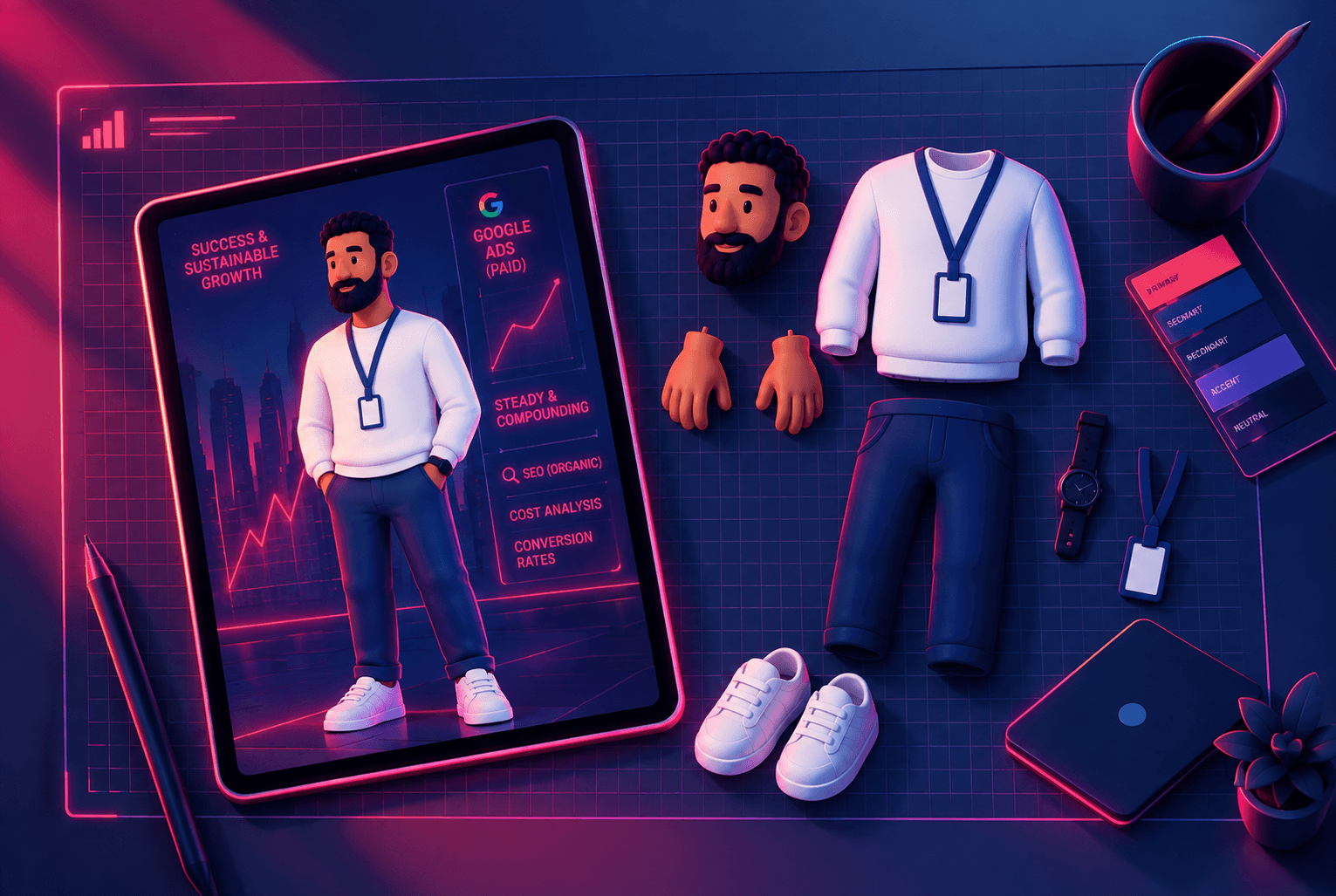
The Core Components of a Brand-Ready 3D Character
A scalable character should be designed at several levels simultaneously.
1. Visual Identity
Visual identity defines how the character belongs to the brand.
A character should not look like an unrelated mascot placed beside a logo.
Color relationships, shape language, clothing, materials and overall styling can all connect the character to the wider brand identity.
The brand guidelines and character bible should therefore complement each other.
A useful approach is to first define the broader brand system and then determine how the character translates those characteristics into a physical form.
2. Facial Identity
Facial identity contains the characteristics that allow audiences to recognize the same character repeatedly.
This can include:
Head shape
Eyes
Eyebrows
Nose
Mouth
Ears
Facial hair
Skin treatment
Hairstyle
Glasses or permanent accessories
Small changes can have a surprisingly large effect on perceived identity.
For AI-assisted or traditional production, Animus Agency documents these details in an approved character bible and reference system.
3. Body Proportions
The character needs a defined physical structure.
A stylized character might be five heads tall, while another character may use more realistic proportions.
What matters is not choosing one universal ratio.
What matters is preserving the selected ratio once the character has been approved.
Shoulder width, torso length, hand scale and leg proportions should not randomly change between scenes.
4. Personality
A good branded character communicates personality before speaking.
Posture, facial expression, gesture and movement can suggest whether the character is:
Confident
Playful
Experienced
Energetic
Calm
Friendly
Serious
Intentionally awkward
Personality becomes particularly important when characters enter video.
A character's behavior should reinforce the brand rather than become a separate creative identity.
5. Wardrobe and Accessories
Some character elements should remain fixed. Others should be intentionally variable.
For example, glasses might be identity-defining while clothing changes between campaigns.
Teams should decide this deliberately.
Otherwise, AI systems may preserve the wrong characteristics while changing the important ones.
The same principle applies to branded products. If the character regularly interacts with a product, the product itself should have a persistent identity system.
Animus Agency applies the same discipline to branded products, ensuring packaging, proportions, colors, labels, and important features remain accurate across creative outputs.
6. Motion Behavior
A 3D character intended for animation needs motion logic.
How does the character walk?
How exaggerated are the gestures?
How expressive is the face?
Does the character behave like a polished 3D film character, a simplified motion-design character or something between the two?
Motion should extend the identity rather than replace it.
The Character Design System Brands Actually Need
A professional character system usually requires more than a finished front-facing render.
Hero Character
Defines the overall approved appearance.
It establishes:
Face
Silhouette
Style
Proportions
Wardrobe
Materials
Core visual identity
This becomes the primary reference for the character.
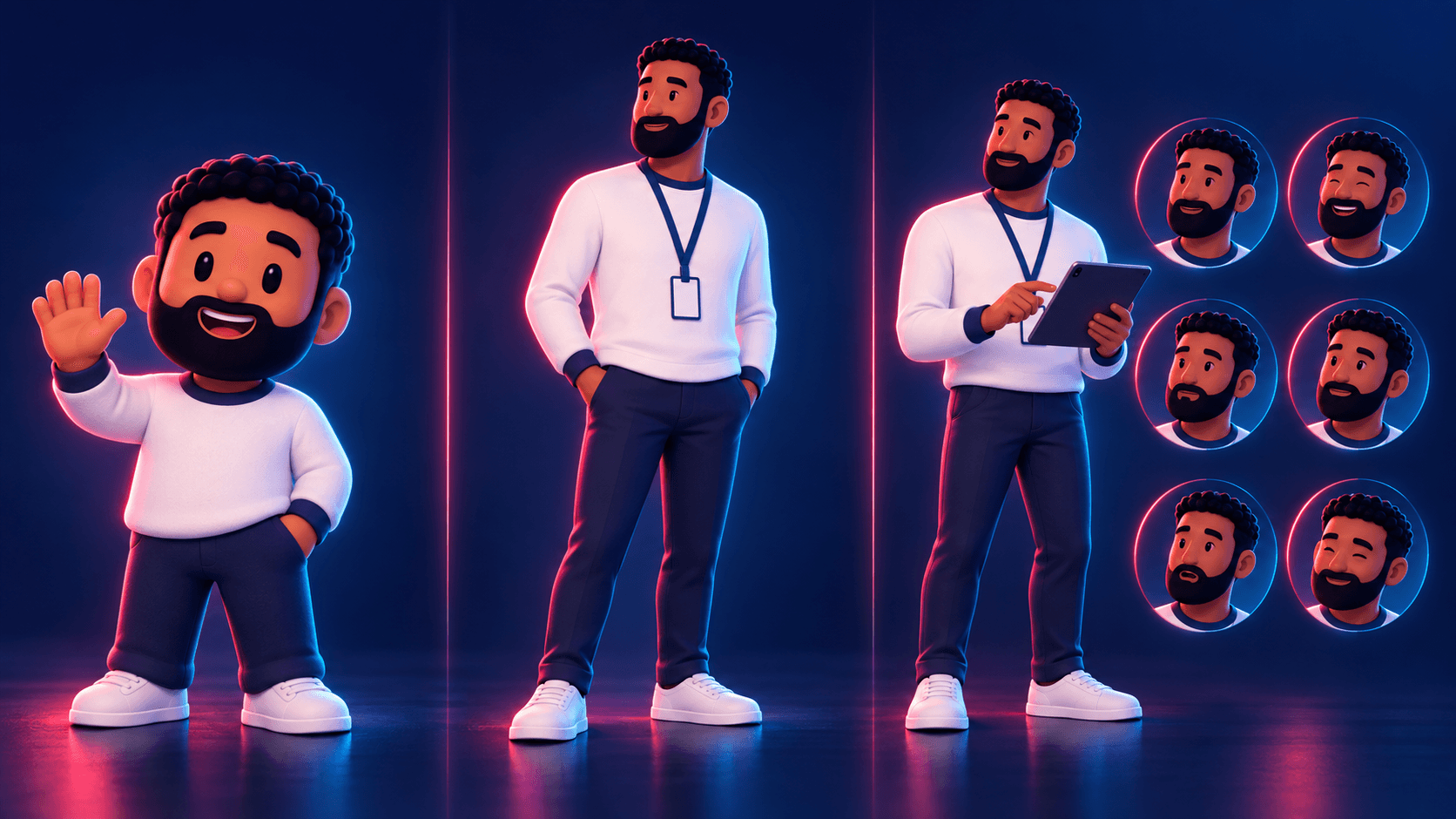
Turnaround Sheet
Includes:
Front view
Back view
Side view
Three-quarter views
A turnaround defines proportions across different camera angles.
It helps answer questions that a single hero image cannot.
How does the hairstyle look from behind?
How does the nose look from the side?
How wide are the shoulders?
Where do the clothing elements sit?
Expression Sheet
Defines the character's emotional range.
Possible expressions include:
Happy
Surprised
Confused
Excited
Serious
Concerned
Confident
Curious
The goal is not simply to create many expressions.
The goal is to establish how the character expresses emotion without changing identity.
Pose Sheet
Defines body language and personality.
Useful poses may include:
Standing
Walking
Sitting
Pointing
Holding a product
Presenting
Looking at a screen
Celebrating
Thinking
The pose system should reflect actual marketing use cases.
Hand Pose Sheet
Hands become especially important when the character interacts with products or technology.
Document gestures such as:
Pointing
Holding
Typing
Using a phone
Presenting
Waving
Giving a thumbs-up
This reduces inconsistency in close-ups and product scenes.
Lip-Sync Sheet
If the character will speak, mouth behavior needs to be considered early.
A lip-sync system can define:
Mouth shapes
Speech movement
Facial behavior
Voice requirements
Language requirements
This becomes particularly important for brands producing both Arabic and English character-led content.
Character Bible and Production References
The final layer is persistent identity information.
Traditional character documentation tells a human artist what to preserve.
Animus Agency’s character bible makes that identity reusable across designers, animators, editors, and future campaign teams.
For brands using AI, this can turn a character from a reference image into a reusable production asset.

3D Character Design Deliverables Checklist
When comparing artists, studios or AI-assisted production partners, confirm that the project includes the right level of documentation.
Strategy Brief
Confirm:
Audience
Character role
Personality
Brand relationship
Intended channels
Hero Design
Confirm:
Final style
Proportions
Wardrobe
Materials
Core appearance
Turnaround
Confirm:
Front
Back
Side
Three-quarter views
Expression System
Confirm:
Emotional range
Facial behavior
Brand-appropriate expressions
Pose System
Confirm:
Standing
Sitting
Movement
Signature gestures
Hand System
Confirm:
Product interaction
Phone interaction
Pointing
Grip
Object handling
Wardrobe Rules
Confirm:
Permanent identity elements
Changeable clothing
Accessories
Seasonal variations
Motion Guide
Confirm:
Gesture scale
Walk
Timing
Facial behavior
Animation style
Lip-Sync Guide
Confirm:
Mouth shapes
Dialogue requirements
Language requirements
Voice requirements
Source Files
Confirm:
Editable files
Textures
Rigs
Export formats
Long-term access
Usage Rights
Confirm:
Commercial rights
Channels
Regions
Duration
Ownership
Character Bible
Confirm:
Persistent identity information
Animation and AI-assisted production compatibility
Reusable Animus Agency workflows
Request the exact file formats, rig requirements, polygon or rendering specifications, revision rounds and ownership terms before production begins.
Two proposals may show similar hero renders while delivering very different long-term value.
How to Measure 3D Character
A branded character creates value through reuse, recognition and production efficiency.
Track:
Campaigns using the character
Approved assets created per campaign
Time needed to produce a new variation
Revision rounds caused by character drift
Cost per approved character asset
Engagement and completion rate against non-character creative
Brand recall or character recognition
Leads, sales or product actions influenced by character-led campaigns
Use this operational formula:
Character cost per use = Total character-system investment ÷ Approved commercial uses
For example, a $12,000 character system used across 60 approved campaign assets has a design cost of $200 per use before ongoing production costs.
The same investment used only twice costs $6,000 per use.
This does not mean more appearances automatically create more value.
Every use should serve a real campaign purpose.
The metric simply helps buyers distinguish a reusable brand asset from an expensive one-off render.
Animus Agency also evaluates character ROI within the wider video and campaign system, where each approved character asset can support films, social cutdowns, stills, explainers, and future content.
Establish a Baseline Before Scaling
Before adopting a persistent character workflow, measure:
Average time from brief to approved character asset
Percentage of generations rejected for identity drift
Average correction or regeneration cost
Time required to create another pose, scene or language version
Then compare the same metrics after implementing the character system.
This gives the team a clearer picture of whether the character is actually improving production efficiency.
Common 3D Character Design Mistakes
Designing Only the Front View
A character can look excellent from the front and fail immediately when rotated.
Why it matters: Advertising and animation require different camera angles.
Better approach: Validate the design through a turnaround before building campaign assets.
Changing Proportions Between Outputs
Slight changes in head size, shoulders, limbs or body shape can make a character feel different even when the face remains similar.
Why it matters: Audiences perceive identity through the entire silhouette, not only the face.
Better approach: Define and preserve proportions as part of the character system.
Treating Wardrobe as Identity
AI can sometimes attach too much identity to clothing.
If every characteristic is locked together, seasonal or campaign-specific wardrobe changes become difficult.
Better approach: Decide what belongs to permanent character identity and what can intentionally change.
Designing the Character Separately From the Brand
A technically impressive character can still fail commercially if it feels disconnected from the company it represents.
Better approach: Animus Agency develops the character bible alongside the brand guidelines so the character belongs naturally inside the visual system.
Ignoring Future Animation
A static character does not automatically become a good animated character.
Expressions, hand movements, lip sync, body language and silhouette need to survive motion.
Better approach: Design with the final production formats in mind.
Step-by-Step: How to Create 3D Character Design for Brands
Step 1: Define the Character's Job
Start with what the character must accomplish, not what it should look like.
Is it:
A mascot?
A digital spokesperson?
A recurring campaign character?
A product guide?
A character for explainer films?
The use case influences everything that follows.
A character expected to deliver dialogue needs different production preparation from a mascot appearing mainly in static social posts.
Step 2: Connect the Character to the Brand Identity
Identify the visual characteristics already associated with the brand.
Consider:
Brand colors
Shape language
Typography
Visual tone
Audience
Cultural context
Brand personality
The character does not need to literally wear every brand color.
It needs to feel as though it belongs to the same universe.
Step 3: Establish the Character Concept
Define the character's broad appearance and personality.
At this stage, explore rather than prematurely locking every detail.
Once a direction is approved, move from exploration to controlled development.
Step 4: Build the Turnaround
Create consistent views from the front, side, back and three-quarter angles.
This forces the design to answer questions a hero image can hide.
How does the hairstyle work from behind?
How large is the nose from the side?
What is the exact body silhouette?
Where do clothing elements sit?
The turnaround becomes a structural reference.
Step 5: Define Expressions and Poses
Now test personality.
Create expressions relevant to actual marketing situations rather than arbitrary emotion sheets.
If the character is a reassuring financial guide, its emotional range may differ from an entertainment mascot.
Pose sheets should test the same principle through body language.
Step 6: Prepare for Speech and Animation
If the character will speak, define mouth behavior and lip-sync requirements.
For multilingual brands, this becomes even more important because the character may need to perform across languages and regional campaigns.
Arabic-first brands should also consider how voice, language and visual identity work together rather than treating localization as a final production step.
Step 7: Build the Animus Character Bible
Once the character is approved, Animus Agency turns its identity into reusable production documentation. The character bible brings together the approved hero design, turnaround, facial features, proportions, expressions, poses, wardrobe rules, motion behavior, and brand relationships.
Instead of treating each new asset as an isolated request, every Animus Agency artist and production partner works from the same approved reference system. This protects the character when the creative output changes.
Practical test: Take one approved character and create ten deliberately different outputs. Test poses, angles, expressions, environments and product interactions. Measure how many are approved without manual correction.
Step 8: Test the Character in Real Campaigns
Do not approve consistency based on one additional image.
Test the character across genuinely different scenarios:
Close-up
Full body
Side view
Different expressions
Indoor environment
Outdoor environment
Product interaction
Animation
Dialogue
Campaign variation
A production-ready character should survive creative change without losing identity.
3D Character Design for Marketing Campaigns
A marketing character becomes valuable when the same identity can participate in multiple campaign ideas without being redesigned.
Consider a brand introducing a recurring 3D spokesperson.
The launch campaign might feature the character in a hero film.
The next phase could require:
Vertical social videos
Static posts
Explainers
Product interactions
Seasonal content
Promotional campaigns
Landing-page visuals
Traditionally, every extension requires careful art direction to ensure continuity.
AI makes creating those variations faster, but it also creates more opportunities for drift.
This is why Animus Agency connects the character bible to a wider production-consistency workflow built around four layers:
Character consistency
Product consistency
Environment consistency
Brand consistency
A campaign can therefore preserve more than the character's face.
It can also preserve the product, environment and overall brand identity.
This becomes especially useful when Animus Agency moves from character development into commercials, branded films, or social campaigns where the same identity must survive multiple scenes and shots.
3D Character Design for Agencies
For agencies, the commercial challenge is not creating one branded character; it is managing character identity across clients, campaigns and production teams.
An agency may build a character successfully during concept development and then need to hand it across designers, animators, copywriters and campaign teams.
Without a shared system, knowledge fragments.
One person has the final turnaround.
Another has the best prompts.
Another knows which generation looked correct.
Another knows which clothing elements can change.
Another knows how the character should behave in video.
This is exactly the type of fragmentation an Animus Agency character bible and centralized production workflow are designed to reduce.
For agencies, the result is not simply faster character generation.
The larger benefit is production control.
The same approved character identity can remain connected to the workflows used to create campaign content.
Animus Agency can carry the approved character into a unified campaign across films, social edits, key visuals, explainers, CGI scenes, and platform-specific formats.
3D Character Design for Enterprise Brands
Enterprise character systems introduce another variable: governance.
The more people creating content, the easier it becomes for a character to drift.
A central marketing team may approve one version while regional teams create variations.
Different agencies may interpret guidelines differently.
Campaign teams may use different AI models.
For enterprise production, three questions become important:
What elements are approved?
What elements can change?
How does the production system preserve that distinction?
Brand guidelines and the approved character bible provide a foundation for those decisions.
The goal is not to prevent creative variation.
The goal is to ensure that variation happens inside the boundaries of the approved identity.
3D Mascot vs Brand Character vs Character System
These terms are related, but they describe different levels of commitment.
3D Mascot
A 3D mascot is primarily a recognizable brand symbol.
It may appear in:
Selected campaigns
Social posts
Events
Product touchpoints
Promotional assets
It works well for brands that want a memorable visual representative without requiring extensive character storytelling.
Brand Character
A brand character adds personality and storytelling.
It may appear repeatedly in:
Advertising
Social content
Explainer videos
Product storytelling
Campaigns
The focus is not only recognition but also personality.
Character System
A character system is designed for repeatable production.
It defines:
Visual identity
Expressions
Poses
Motion
Wardrobe
Interaction rules
Production references
Usage rules
This is the stronger approach for teams scaling characters across image, video and marketing workflows.
Persistent Character Bible
An Animus Agency character bible adds a persistent production layer. It allows the approved identity to remain reusable across traditional and AI-assisted workflows instead of relying on one reference image every time.
The progression is therefore:
Mascot → Brand Character → Character System → Animus Production Bible
The difference is not simply visual quality.
It is repeatability.
Limitations of AI 3D Character Design
AI does not eliminate the need for art direction.
Generative models can interpret the same character differently depending on:
Camera angle
Prompt
Reference
Environment
Model behavior
Lighting
Motion
Human review remains important for:
Anatomy
Cultural appropriateness
Expression quality
Product interaction
Brand fit
Visual hierarchy
Final campaign approval
Persistent identity also does not mean every output should be identical.
Good character systems need controlled variation.
The character should be able to change pose, expression, environment and sometimes clothing without losing the defining characteristics that make it recognizable.
The goal is not visual rigidity.
It is controlled creative freedom.
Best Practices for Consistent Branded 3D Characters
Define What Cannot Change
Identify the characteristics that create recognition.
Define What Can Change
Separate identity from campaign-specific elements such as wardrobe, props or environments.
Build the Turnaround Before Scaling
Do not discover the character's side profile halfway through a campaign.
Test Expressions Early
A character that only works with one neutral expression is not production-ready.
Connect the Character Bible With Brand Guidelines
Character consistency without brand consistency can still produce disconnected creative.
Design Environments Deliberately
If recurring scenes matter, Animus Agency also documents environment rules, including architecture, props, palette, lighting, and atmosphere.
Test Across Image and Video
A character that works in still imagery may behave differently once animated.
Keep Human Art Direction in the Workflow
Consistency infrastructure reduces repetitive reconstruction.
It does not replace creative judgment.
How Animus Agency Turns Character Design Into Campaign Infrastructure
Animus Agency develops branded characters as reusable production assets—not isolated 3D renders. The workflow connects strategy, character design, animation, motion graphics, CGI, sound, editing, and campaign adaptation under one creative direction.
Character Strategy and Design
Animus Agency defines the character’s communication role, personality, visual style, cultural context, brand relationship, and long-term campaign uses before production begins.
Character Development
The Animus team creates the hero design, turnaround, expression sheet, pose system, hand references, wardrobe rules, materials, and production-ready character bible.
Animation and Film Production
The character moves into story, script, storyboarding, environments, scene production, voiceover, lip sync, animation, and final film. Adobe’s animation overview provides additional background on common animation techniques.
Campaign and Social Adaptation
Animus Agency can adapt the approved character into social videos, campaign visuals, explainers, CGI content, event screens, cutdowns, thumbnails, and localized Arabic or English versions.
Post-Production and Quality Control
Editing, VFX, compositing, sound design, color, upscaling, and final quality control keep the character consistent across every delivered format.
This integrated workflow matters because branded characters rarely stay in one format. A character begins as a design, becomes a scene, grows into a film, and can then support an entire campaign. Animus Agency keeps the same approved identity connected throughout that process.
How to Decide Whether Your Brand Needs a 3D Character
A 3D character is worth considering when it has a clear communication job.
Consider a Character When:
Your brand needs a recurring visual personality
You produce frequent social or video content
Storytelling is important to your marketing
Your product or service needs explanation
You want a recognizable campaign asset
The character will be reused across multiple formats
Do Not Create a Character Simply Because AI Makes It Possible
If the character has no defined role, personality or long-term production use, a strong conventional visual identity may serve the brand better.
The business case becomes stronger when the character can accumulate recognition through repeated use.
That requires consistency.
Character System Readiness Score
Give the character one point for every “yes”:
Does the character have a specific marketing or communication role?
Is the silhouette recognizable without facial detail?
Are face and body proportions documented?
Has the character passed front, side, back and three-quarter review?
Are core expressions and gestures approved?
Are fixed and variable wardrobe elements separated?
Has the character been tested holding the actual product?
Does it remain recognizable in both stills and motion?
Are source files, commercial rights and governance rules clear?
Can another team reproduce the character without relying on its original designer?
8–10 points: Ready for campaign-scale production.
5–7 points: Strong concept, but reuse may create corrections or drift.
0–4 points: Treat the current asset as a concept and complete the character system before scaling.
A Practical Animus Character-System Pilot
Use one approved character and create a controlled test set:
Close-up neutral portrait
Full-body front view
Side profile
Three-quarter action pose
Happy and concerned expressions
Product interaction
Indoor and outdoor scenes
Short dialogue clip
One Arabic voiceover variation
Score every output for:
Face
Silhouette
Proportions
Wardrobe
Personality
Brand fit
Product interaction
Then calculate:
Approval rate = Approved outputs ÷ Total generated outputs × 100
The pilot gives marketing teams and agencies a more useful buying signal than one polished demo image.
Conclusion: 3D Character Design for Brands Should Be Built to Last
The most useful 3D character design for brands does more than produce an attractive mascot.
It creates a recognizable identity that can move through images, videos, campaigns, environments, languages and new creative ideas without being rebuilt from scratch.
Reference images can guide individual generations.
A scalable production workflow needs persistent identity.
That is why Animus Agency combines character design, brand rules, product accuracy, environment direction, animation, and post-production inside one connected workflow.
The goal is to move character creation from an isolated render into controlled, repeatable creative production.
Ready to turn one approved character into a reusable brand asset? Explore Animus Agency and build a character system designed for films, campaigns, social content, and long-term brand storytelling.
Frequently Asked Questions
1. How much does 3D character design for brands cost?
The cost depends on the required design depth, number of characters, turnaround views, expression sheets, animation requirements and campaign deliverables.
A one-off mascot illustration is fundamentally different from building a production-ready character system.
Brands should compare proposals based on reusable deliverables and production requirements rather than character appearance alone.
2. How do you implement a 3D brand character across marketing campaigns?
Start by defining the approved character identity, turnaround, proportions, expressions and variable elements.
Then connect the character to the brand's visual rules and test it across actual campaign scenarios.
For AI-assisted or traditional production, the Animus Agency character bible carries the approved identity into subsequent image, video, and marketing workflows.
3. Is a 3D mascot different from a brand character system?
Yes.
A 3D mascot can be a single recognizable representative used in selected communications, while a character system defines how that identity behaves across poses, expressions, scenes, animation and campaigns.
Brands planning frequent character-led content usually need the broader system because repeatability becomes as important as the original design.
4. Can AI reduce the cost of producing branded 3D character content?
AI can reduce some repetitive production work and make creative variation more accessible, but it does not remove art direction, review or consistency requirements.
The commercial benefit depends on the workflow.
Reusable character identity becomes particularly valuable when a brand needs many campaign variations rather than a single finished character image.
5. What outcomes should a brand expect from a consistent 3D character?
A consistent character gives the brand a reusable creative asset for storytelling, advertising, social content, explainers and video.
The primary outcome is not simply more content.
It is the ability to extend the same recognizable character into new creative situations without redesigning its identity for every campaign.
6. What is a character bible in 3D production?
An Animus Agency character bible is a structured record of the features that define a recurring character, including appearance, proportions, personality, expressions, poses, wardrobe, and motion rules. It turns a one-time visual reference into a reusable production asset.
7. Can the character system include products and environments?
Yes.
For complex campaigns, the character may need to remain consistent while also interacting with the same product and appearing in recurring environments.
Yes. Animus Agency can combine character, product, environment, and brand references into a more complete consistency system for animated and AI-assisted campaigns.
8. Is 3D character design useful for social media?
Yes, especially for brands producing recurring content.
A recognizable character can become a visual anchor across Reels, short-form videos, posts, explainers, promotional content and seasonal campaigns.
The key is making sure the character remains recognizable as the content changes.
9. What is the biggest mistake brands make with AI characters?
The biggest mistake is treating one successful generation as proof of consistency.
A character should be tested across different angles, expressions, poses, environments, products and video scenarios before being considered production-ready.
10. When should a brand invest in a reusable character system?
A reusable character system makes the most sense when the character will appear repeatedly across campaigns and formats.
If a character will only be used once, a full production system may not be necessary.
If it will appear across dozens or hundreds of assets, investing in repeatability can significantly improve production efficiency and brand recognition.