How Creative Agencies Use AI Without Losing Brand Consistency

Learn how AI brand consistency helps agencies scale images, video and campaigns while protecting brand identity across teams, models and markets. Explore the guide.
AI Brand Consistency: How Animus Agency Scales AI Without Brand Drift
AI brand consistency means using AI to increase creative production without losing the visual, verbal and creative identity that makes a brand recognizable.
For a creative agency, that problem is bigger than generating a good image or video.
The real challenge starts when one campaign becomes 20 assets, then 100 assets, then multiple formats, markets, languages and channels.
The first video may look right.
The second may still feel right.
But as more creators, AI models and production techniques enter the workflow, small differences begin to appear. A product changes shape. A character's face shifts. An environment becomes inconsistent. Typography is treated differently. The tone of the copy changes. A localized version no longer feels connected to the original campaign.
At Animus Agency, we see this as a creative production problem.
Animus works across campaign strategy, branding, social content, commercials, animation, CGI, 3D, motion graphics, AI creative technology, VFX, filming and post-production. The agency's production model is broader than AI generation alone.
That matters because a modern campaign does not necessarily use one production technique.
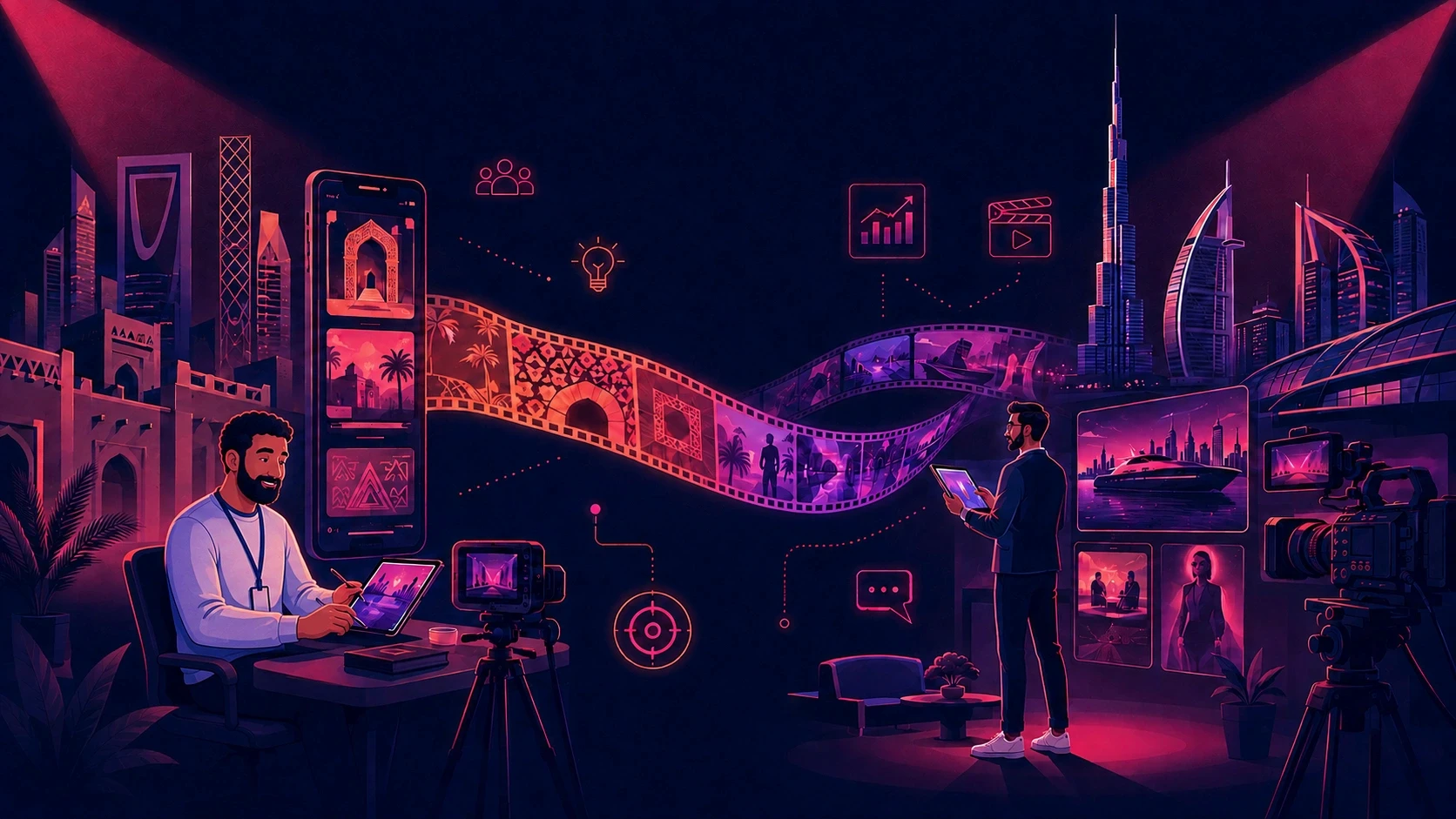
A commercial may combine live action, CGI, 3D animation, AI-generated scenes, motion graphics and VFX. The technology can change from shot to shot while the brand identity remains recognizable.
That is the production challenge Animus has been solving through years of creative work.
And it is also the problem that led Animus to build ALStudio.ai, a Creative AI OS designed around connected workflows and persistent creative identity.
The lesson is simple:
AI can generate content. An agency has to make that content belong to the brand.
What Is AI Brand Consistency?
AI brand consistency is the process of using generative AI while maintaining a recognizable brand identity across images, video, characters, products, environments, copy and campaigns.
Traditional brand guidelines already define important elements such as:
Logo
Colors
Typography
Photography direction
Tone of voice
Visual style
Brand personality
AI production introduces another layer.
Teams now need to consider:
How should the same product appear across different generated scenes?
How should a recurring character remain recognizable?
How should an environment stay visually connected across shots?
How should a campaign survive different AI models?
How should English and Arabic versions remain part of the same brand system?
How should AI-generated content connect with CGI, animation and live-action production?
These are production questions.
That is why Animus approaches AI as one part of a broader creative production system.
Why AI Brand Consistency Matters to Animus
Animus was established in 2017 and works across storytelling and creative media, including commercials, animation, branding, corporate content and other visual production.
Today, the agency's Studio offering covers areas including AI and creative technology, CGI, 3D animation, motion graphics, VFX, filming and social media video production.
That range changes how AI production is approached.
The question is not:
"Can AI generate this?"
It is:
"What is the right production method for this creative problem, and how do we keep the final campaign coherent?"
For example, one campaign could use:
Live action for a real person
CGI for a product environment
3D for a branded character
AI for concept development or supporting scenes
Motion graphics for information
VFX for compositing
Professional editing for the final film
The audience should experience one campaign.
They should not feel as though six unrelated technologies were combined.
That is where brand consistency becomes a production discipline.
The Agency Cost of Brand Drift
Brand drift creates work after the generation has already happened.
When an asset moves away from the approved identity, someone has to:
Identify the problem
Explain the problem
Regenerate the asset
Re-edit the scene
Recheck the product
Communicate with the client
Repeat the approval process
At small volumes, this may be manageable.
At agency scale, it becomes a production cost.
Imagine an agency creates 100 social assets for a campaign.
If 20 require significant revisions because of product, character, visual or messaging inconsistencies, the real workload is not simply 100 generations.
It is:
100 generations + review + correction + regeneration + post-production + approval.
This is why Animus focuses on the difference between generated output and usable creative output.
The goal is not simply to create more.
The goal is to increase the percentage of creative work that reaches approval and can actually be deployed.
How Animus Approaches AI Brand Consistency
At Animus, we think about consistency by separating creative constants from creative variables.
Creative Constants
These are the elements that should remain recognizable.
They can include:
Brand identity
Logo
Color system
Typography
Product appearance
Recurring characters
Environment
Visual language
Brand tone
Design conventions
Creative Variables
These are the elements the creative team should be able to change.
They can include:
Campaign idea
Script
Hook
Camera angle
Composition
Location
Format
Duration
Language
Platform
Offer
Visual treatment
This distinction gives the creative team room to experiment without forcing the brand to change every time the campaign changes.
Consistency should protect identity, not eliminate creativity.
Why AI Brand Consistency Breaks
AI brand consistency often breaks because context is reconstructed repeatedly.
A typical agency workflow might look like this:
A creative team develops the campaign.
A designer creates key visuals.
A video team takes the product into an AI video workflow.
A social team creates short-form variations.
Another creator develops UGC-style content.
A copywriter creates captions.
A localization team creates Arabic versions.
Each person may understand the brand.
But each person may be working from a slightly different interpretation of it.
The result is a campaign where every asset looks individually acceptable but the collection does not feel like one coherent system.
This is the difference between:
AI generation
and
AI-assisted production.
Why Better Prompting Is Not Enough
Detailed prompting remains useful.
Prompts can define:
Camera
Lighting
Composition
Character behavior
Product placement
Environment
Motion
Style
Tone
But a prompt is still an instruction for a generation.
It is not necessarily a persistent production system.
If an agency works with the same client every month, the team should not have to reconstruct the client's identity from scratch every time.
The same applies to recurring products, characters and environments.
As production volume increases, persistent creative context becomes more valuable.
This is one of the lessons Animus encountered while developing AI-assisted production workflows and eventually building ALStudio.
Four Layers of AI Brand Consistency
At Animus, AI brand consistency can be understood through four connected layers.
1. Brand Consistency
This covers:
Logo
Colors
Typography
Visual language
Brand tone
Design conventions
This is the foundation of the brand.
2. Character Consistency
This covers:
Face
Hair
Body proportions
Wardrobe
Expressions
Poses
Personality
Recognizable features
It becomes especially important for mascots, digital presenters and recurring campaign characters.
3. Product Consistency
This covers:
Shape
Packaging
Labels
Materials
Colors
Proportions
Physical details
For ecommerce and advertising, product consistency is critical because the product itself is part of the message.
4. Environment Consistency
This covers:
Location
Architecture
Furniture
Lighting
Props
Spatial relationships
Recurring visual details
It becomes important when a campaign uses a recurring world or location.
These four layers should work together.
A character can remain consistent while the product changes.
A product can remain accurate while the environment changes.
A campaign can contain the correct logo while its overall visual language drifts.
That is why consistency needs to be treated as a system rather than one isolated setting.
A Real Animus Example: ULA.ai
One of the clearest examples of this approach is Animus's work with ULA.ai.
Animus partnered with ULA.ai from the early stages of the brand, developing the identity system, characters Saqr and Ula, and a wider visual universe for the brand. The work extended across the app, website, onboarding experience, animations, educational content, feature explainers and social media.
The important part is that the characters were not treated as one-off illustrations.
They became part of a reusable brand universe.
That meant defining:
Character appearance
Expressions
Poses
3D versions
Brand colors
Typography
Visual language
Digital environments
Content applications
The project demonstrates an important principle:
A branded character becomes more valuable when it can survive beyond one image.
It can become part of:
Animation
Social content
Explainer videos
Product experiences
Digital onboarding
Marketing campaigns
Future creative concepts
This is exactly the type of production problem that becomes more important when AI is introduced.
AI can make character variations faster.
But the agency still needs to know what makes the character the same character.
Animus Combines AI With CGI, 3D and Traditional Production
Animus does not approach AI as a replacement for every other production technique.
The right approach depends on the brief.
A campaign may require:
AI + CGI + 3D + live action + animation + motion graphics + VFX
rather than one technology for everything.
Animus's Studio offering reflects this broader production model, with capabilities spanning AI and creative technology, CGI, 3D animation, motion graphics, VFX, filming and social content.
This hybrid approach is particularly useful for brand consistency.
For example:
A product can be captured through live action.
A digital environment can be created through CGI.
A character can be developed in 3D.
Supporting scenes can use AI.
Motion graphics can communicate product information.
VFX can combine the elements.
Editing can turn them into one commercial.
The production technology changes.
The creative identity does not.
Animus also explores this hybrid relationship in its work around CGI advertising, where traditional CGI and generative AI can be combined depending on the accuracy, creative flexibility and production requirements of the campaign.
AI Brand Consistency for Commercial Production
Commercial production makes the consistency problem particularly visible.
A commercial might contain:
Product shots
Characters
Multiple environments
Voiceover
Dialogue
Motion
CGI
VFX
Multiple aspect ratios
Localized versions
A strong workflow therefore needs to manage the commercial as a production, not a sequence of disconnected AI clips.
Animus's AI commercial production workflow moves through stages such as:
Brief → Creative Constants → Script → Storyboard → Style Frames → Shot Planning → Model Selection → Generation → Audio → Editing → Quality Control → Master Commercial → Campaign Variants
This approach keeps the creative direction above individual AI generations.
The model can change.
The shot can change.
The format can change.
The underlying campaign identity remains controlled.
AI Brand Consistency for Ecommerce
Ecommerce brands have an especially obvious product-consistency problem.
One product may need:
Product-page images
Lifestyle photography
Social ads
Product videos
CGI visuals
Promotional content
Seasonal campaigns
UGC-style creative
The environment can change.
The camera can change.
The campaign message can change.
The product should remain recognizable.
This is where product identity becomes an important production layer.
Animus can combine CGI, AI, 3D, animation and traditional production depending on whether the ecommerce campaign requires realism, stylization, product accuracy or rapid creative variation.
AI Brand Consistency for Social Media
Social media increases content volume.
A campaign may need new creative every week.
The risk is not necessarily that every post looks completely wrong.
The more subtle risk is that the campaign slowly loses its visual identity.
A better approach is to establish recurring creative conventions.
For example:
Keep consistent
Product treatment
Character
Color language
Typography
Visual world
Brand tone
Change intentionally
Hook
Story
Camera
Format
Message
Platform
Offer
This gives the campaign enough variation to remain useful while preserving recognition.
For agencies, the advantage is that creative teams can work faster without treating every post as a completely new visual identity exercise.
AI Brand Consistency Across Markets
Localization introduces another challenge.
A campaign may need:
English
Arabic
Saudi Arabic
Egyptian Arabic
French
German
Other market-specific versions
Localization should adapt communication without accidentally redefining the brand.
That means separating:
Localization Variables
Language
Voice
Dialect
Cultural references
Offer
Market-specific messaging
Platform
from:
Brand Constants
Product
Logo
Visual identity
Character
Brand world
Core creative direction
For Animus, this is particularly relevant to MENA production, where Arabic can require more than direct translation.
Voice, phrasing, cultural context and visual execution can all need adaptation while the underlying campaign remains recognizable.
How to Build an AI Brand Consistency Workflow
Step 1: Start With the Brand
Document the existing brand system before opening an AI generator.
Define:
Visual identity
Colors
Typography
Logo
Tone
Photography
Illustration
Motion
Brand personality
Step 2: Identify Recurring Assets
Determine what will appear repeatedly.
Does the campaign have:
A product?
A spokesperson?
A mascot?
A recurring character?
A specific environment?
A recognizable visual world?
Step 3: Separate Constants From Variables
Write down:
What must remain recognizable?
and:
What can change?
This prevents teams from either allowing uncontrolled drift or over-constraining the campaign.
Step 4: Develop the Master Creative
Create the main campaign concept first.
This establishes the visual and narrative reference for future variations.
Step 5: Choose the Right Production Method
Decide which parts should use:
Live action
AI
CGI
3D
Animation
Motion graphics
VFX
The production technique should follow the creative requirement.
Step 6: Approve the Hero Assets
Before creating dozens of variations, approve the foundation.
The hero assets establish what "correct" looks like.
Step 7: Scale the Campaign
Once approved, extend the creative into:
Social versions
Paid ads
Cutdowns
Product visuals
Alternative hooks
Different aspect ratios
Localized versions
The goal is to reuse creative decisions rather than repeatedly rebuild them.
How Animus Measures AI Production Efficiency
Brand consistency should not be treated only as an aesthetic issue.
For an agency, it can also be measured operationally.
Useful metrics include:
First-Pass Approval Rate
How many assets are approved without major revisions?
Regeneration Rate
How many assets need to be regenerated because of identity problems?
Revision Rounds
How many rounds are required before client approval?
Production Setup Time
How much time is spent reconstructing brand context?
Time to First Approved Asset
How quickly can the agency move from brief to usable creative?
Usable Output Rate
What percentage of generated assets actually become deliverables?
Cost Per Approved Asset
How much does the agency spend producing one approved asset?
These measurements provide a more useful picture of AI production than simply counting how many images or videos were generated.
Where ALStudio Fits Into Animus's Production Workflow
ALStudio came from the production problems Animus encountered while working with AI.
The question was not simply:
"How do we generate an image?"
It was:
"How do we produce hundreds of connected assets without rebuilding the same creative context every time?"
That led to persistent identity layers around:
Brand DNA
Character DNA
Product DNA
Environment DNA
These became part of ALStudio's Consistency Engine.
The wider platform connects this persistent identity with different production workflows:
Content Studio
For briefs, scripts, captions, campaign copy, landing pages, emails and other written production.
Film Studio
For structured film production from story idea and script through storyboard, characters, environments, scenes, voiceover and final film.
Marketing Studio
For campaign objectives, social content and campaign variations.
Editor Studio
For editing, VFX, transitions, upscaling, background replacement, object removal and finishing.
Constants Studio
For the shared creative memory layer containing Brand DNA, Character DNA, Product DNA, Environment DNA and other persistent creative information.
This architecture reflects something Animus learned through agency production:
The generation model is only one part of the workflow.
From Animus Agency Experience to Creative AI Infrastructure
ALStudio was not created separately from agency production.
It came from it.
Animus's published work on ALStudio explains that the platform grew from practical agency problems around fragmented writing systems, image generators, video models, voice platforms, campaign workflows and editing environments.
That experience led to a different way of thinking about AI.
Instead of asking only:
"Which AI model creates the best output?"
Animus started asking:
"How does the production team maintain creative identity when the workflow changes?"
That question is important because AI models will continue to change.
The production requirements do not disappear.
Brands still need:
Strategy
Creative direction
Storytelling
Brand control
Product accuracy
Character continuity
Localization
Editing
Quality control
Approval
The model is a production component.
The creative system sits above it.
When Does an Agency Need Persistent AI Brand Identity?
Not every project needs a sophisticated consistency system.
A one-off image may work perfectly well with a reference and a detailed prompt.
The requirement changes when an agency starts producing:
Recurring characters
Product campaigns
Multiple commercials
Large social campaigns
Multiple markets
Multiple languages
Multiple AI models
High-volume ecommerce content
Recurring monthly campaigns
Enterprise creative
The more frequently an identity is reused, the more useful persistent creative context becomes.
This is particularly relevant for agencies because the same production team may manage many different brands.
The goal is to make sure:
Client A's identity remains Client A's identity.
And:
Client B's identity remains Client B's identity.
AI Brand Consistency Is Not About Making Everything Look the Same
This is one of the most important principles.
A consistent brand should not produce identical content.
A campaign still needs variation.
Different:
Hooks
Stories
Camera angles
Locations
Formats
Messages
Visual treatments
can all be appropriate.
Consistency simply means the audience can still understand that the assets belong to the same brand.
Consistency creates recognition. Variation creates creative interest.
A good production system needs both.
Best Practices for Agencies Scaling AI
1. Start With the Brand
Do not start with the AI model.
Start with the identity.
2. Define What Must Not Change
Identify products, characters, environments and visual conventions that need continuity.
3. Separate Constants From Campaign Variables
Give creative teams room to experiment without requiring them to redefine the brand.
4. Use AI Alongside Other Production Techniques
AI can work alongside CGI, 3D, animation, live action, motion graphics and VFX.
5. Review for Brand Fit
Do not approve an asset simply because it looks impressive.
Ask whether it belongs to the brand and the campaign.
6. Build Reusable Production Context
Avoid making teams reconstruct the same client identity for every campaign.
7. Localize Deliberately
Adapt language, voice and cultural execution while protecting the core brand identity.
8. Measure Usable Output
Track approved deliverables rather than generation volume alone.
9. Keep Creative Direction Human-Led
AI can generate possibilities.
Creative teams decide which possibilities are strategically and creatively appropriate.
Why Animus Treats AI as a Production Capability
Animus's role is not limited to choosing an AI model.
The agency can work across:
Creative strategy
Branding
Campaign development
Commercial production
Animation
CGI
3D
AI creative technology
Motion graphics
VFX
Filming
Post-production
Social content
That allows AI to sit inside a broader production system.
A campaign can begin with a business objective.
The agency develops the creative direction.
A storyboard establishes the visual narrative.
CGI, 3D, AI or live action are selected according to the shot.
The assets are generated or produced.
VFX and editing bring them together.
Localized versions are created.
The final campaign is delivered across channels.
The technology changes according to the requirement.
The creative direction stays connected.
The Future of AI Brand Consistency
AI is making content generation faster.
That changes the production problem.
When creating one asset takes significant effort, teams naturally spend more time reviewing it.
When a team can generate hundreds of assets, the harder questions become:
Which assets are actually on-brand?
Which products are accurate?
Which characters are consistent?
Which scenes belong to the same campaign?
Which versions should be approved?
Which assets can be reused?
Which versions can be localized?
The challenge shifts from generation to control.
For Animus, that is why AI brand consistency is not simply an AI feature.
It is part of creative production.
Conclusion: How Animus Scales AI Without Losing the Brand
AI gives creative agencies the ability to explore more concepts, create more variations and adapt campaigns across more formats.
But more generation creates another challenge:
Brand drift.
Products can change.
Characters can change.
Environments can change.
Visual language can change.
Copy can change.
Localized versions can become disconnected.
Animus approaches this problem by placing AI inside a broader creative production system.
That system can include strategy, branding, storytelling, CGI, 3D, animation, live action, motion graphics, VFX and post-production.
The agency decides what the brand should communicate.
The creative team decides what the campaign should look like.
Production teams decide which technique is appropriate.
AI becomes another production capability inside that system.
The development of ALStudio grew from the same agency experience. Animus needed a way to make AI-assisted production more structured, repeatable and consistent as content volume increased.
That led to a persistent creative identity approach built around:
Brand DNA + Character DNA + Product DNA + Environment DNA.
The principle is straightforward:
Let the creative change. Keep the identity controlled.
For agencies, that can mean less unnecessary regeneration, more reusable production context and a greater percentage of AI-assisted creative reaching approval.
The future of AI production is not simply about generating more.
It is about producing more while maintaining creative control.
And that is where AI becomes valuable to a creative agency: not as a replacement for creativity, but as another production capability inside a system built around the brand.