Saudi Arabia vs UAE: How Should Brand Content Change?
Compare Saudi vs UAE marketing and learn how to adapt Arabic content, messaging, visuals and campaigns while keeping your brand consistent across markets.
Saudi vs UAE Marketing: How Animus Localizes Content Without Losing Brand Consistency
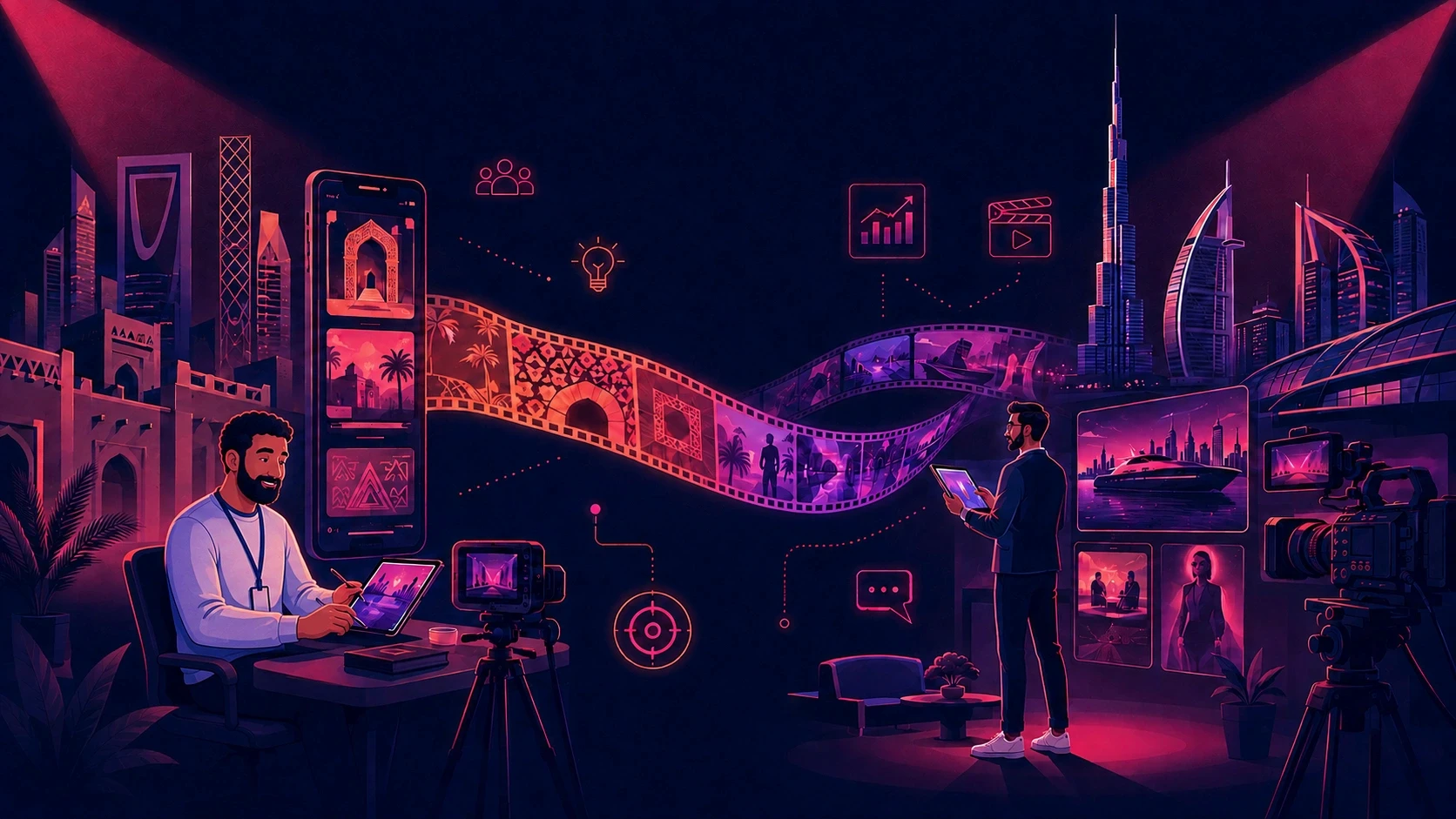
Saudi vs UAE marketing is not simply about translating the same campaign into Arabic. It is about adapting the audience, message, cultural context, production and channel execution while protecting the brand system underneath.
At Animus, we approach regional localization as a creative production challenge. A campaign may need different Arabic messaging, voiceover, talent, environments, formats and calls to action across Saudi Arabia and the UAE, but that does not mean the brand should be rebuilt from scratch for every market.
The goal is controlled localization: change what needs to change, protect what needs to remain consistent, and build every market version from the same strategic and creative foundation.
This is particularly important when one campaign needs to become paid social ads, organic content, product videos, UGC-style videos, CGI, motion graphics and multiple platform formats.
At Animus Agency, strategy, creative direction and production work together so regional campaigns can be developed as connected systems rather than isolated market assets.
How Animus Approaches Saudi vs UAE Marketing
At Animus, we treat localization as part of the campaign itself, not as a final translation step.
The process starts by separating a campaign into two groups.
What stays consistent
These are the elements that make the campaign recognizable:
Brand positioning
Core campaign idea
Product identity
Logo
Brand colors
Typography
Visual language
Key messaging
Character identity
Product packaging
Brand guidelines
What can change
These are the elements that may need market-specific adaptation:
Language
Arabic register or dialect
Headlines
Voiceover
Casting
Cultural references
Wardrobe
Environment
Social context
CTA
Offers
Platform formats
This distinction is central to the way Animus approaches regional campaigns.
The objective is not to make Saudi and UAE content identical. It is to make the two versions feel locally relevant while still belonging to the same brand.
For a broader framework, see Animus's guide to Middle East campaign localization, which explains how global campaigns can be adapted for regional markets without losing their original identity.
Why Saudi and UAE Campaigns Should Not Be Treated as Identical
Saudi Arabia and the UAE are geographically close, but proximity does not mean a single creative execution should automatically be used across both markets.
A Saudi campaign may require an Arabic-first approach, Saudi-specific cultural context and market-specific creative decisions.
A UAE campaign may require more audience segmentation because the market includes different language, nationality, lifestyle and professional groups.
The same product can therefore require different creative decisions while keeping the same brand proposition.
This is why localization should begin with the audience rather than the language.
At Animus, we first ask:
Who is the audience?
What is the campaign objective?
What should remain globally consistent?
What needs to change for the market?
Which language should be used?
Should the content be formal, conversational or dialect-led?
What needs to change visually?
Which platforms will carry the campaign?
Only after these decisions are clear should production begin.
Saudi vs UAE Marketing: What Should Change?
A useful Saudi vs UAE marketing strategy separates brand consistency from market relevance.
Area | Saudi Arabia | UAE |
|---|---|---|
Audience | Define the specific Saudi audience and objective | Segment according to audience, language, city and objective |
Language | Arabic / English depending on campaign | Arabic, English, bilingual or multilingual depending on audience |
Voice | Match the audience and content format | Match language, segment and campaign context |
Visual context | Review Saudi cultural and social relevance | Adapt to the intended audience and campaign context |
CTA | Adapt to the customer journey | Adapt to audience and channel |
Offer | Localize where required | Localize where required |
Brand identity | Keep core identity consistent | Keep core identity consistent |
Production | Build Saudi-specific versions from the master campaign | Build UAE-specific versions from the same creative foundation |
These are not rigid rules. Every category, audience and campaign objective can change the requirements.
A luxury campaign, a B2B campaign, an ecommerce product launch and a social-first UGC campaign may all require different localization decisions.
Saudi Marketing: Where Animus Focuses Localization
Saudi campaigns should be developed around the actual Saudi audience rather than simply translating an English master.
1. Arabic should be considered at the strategy stage
Arabic should not always be treated as a final production layer.
For social videos, UGC, creator-style content and character-led campaigns, spoken Arabic may be part of the creative idea itself.
That means the team needs to consider:
Language
Register
Delivery
Speaker identity
Pacing
Humor
Cultural context
Platform
Written Arabic and spoken Arabic should also be reviewed separately.
Animus explores this broader issue in its guide to Arabic content localization, covering language, dialect, culture, voice, visuals and platform execution.
2. The visual world needs to feel intentional
Localization is not simply adding a Saudi landmark to an existing advertisement.
The production team may need to review:
Casting
Wardrobe
Locations
Architecture
Lifestyle cues
Social interactions
Product context
Typography
Right-to-left layouts
Supporting objects
At the same time, the product and brand identity should remain recognizable.
3. Saudi content should be produced for its final channel
A Saudi campaign may need:
TikTok videos
Instagram Reels
Paid social ads
Product videos
UGC-style content
YouTube videos
Static product visuals
Arabic voiceovers
Short-form variations
These should not become disconnected creative projects.
They should all come from the same campaign logic.
UAE Marketing: Why Audience Segmentation Matters
The UAE requires a different localization question:
Who exactly are we speaking to?
A campaign targeting Emirati consumers may require different creative decisions from an English-language campaign targeting international professionals.
A campaign aimed at Arabic-speaking residents may require another approach.
This means a UAE campaign can involve:
Arabic
English
Bilingual messaging
Multiple audience segments
Different creative formats
Different cultural references
Different channel strategies
The mistake is assuming that one generic "UAE creative" can communicate equally well to every audience.
At Animus, audience definition comes before production.
What Animus Keeps Consistent Across Saudi and UAE Campaigns
The strongest localization systems have a clear set of constants.
Brand
The logo, color palette, typography and overall visual identity should remain controlled.
Product
The product should look like the same product across every market.
Packaging, proportions, labels and key product details need to remain accurate.
Campaign
The central idea and proposition should remain recognizable.
Characters
If a campaign uses a recurring character or spokesperson, localization should not unintentionally create a completely different identity.
Visual Language
Lighting, composition, animation style, CGI direction and overall creative language should remain connected.
This is where production infrastructure becomes important.
Without a defined system, every new market can become a new creative interpretation.
With a defined system, Saudi and UAE versions become controlled variations of the same campaign.
What Animus Localizes
Once the constants are established, Animus can adapt the elements that actually need to change.
Language
Copy, scripts, captions and CTAs can be adapted to the market and audience.
Voice
Voiceover needs to match the language, tone, speaker and content format.
Cultural Context
The campaign may require different environments, social situations, casting or references.
Production
The same campaign can be produced in different aspect ratios, durations and platform formats.
Content Style
A product film, paid advertisement and UGC-style Reel may communicate the same proposition through completely different executions.
The strategic idea remains connected even when the production changes.
Animus Studio: Turning Localization Strategy Into Production
Localization only creates business value when it becomes usable content.
This is where Animus Studio fits into the workflow.
Animus Studio provides production capabilities across:
Commercial video
Social media videos
Motion graphics
CGI
3D animation
AI creative videos
VFX
Filming
Post-production
That matters because localization rarely stops at copy.
A campaign may need a new voiceover, a different edit, localized motion graphics, additional social cuts or entirely new visual scenes.
Instead of treating those as disconnected production tasks, Animus can connect them to the larger campaign strategy.
The Animus Workflow for Saudi and UAE Localization
A practical Animus localization workflow can be structured into nine stages.
Step 1: Define the master campaign
Start with the central proposition, audience, creative idea and brand rules.
Step 2: Identify the constants
Lock the elements that must remain consistent.
Step 3: Build separate market briefs
Create a Saudi brief and a UAE brief.
Each should define:
Audience
Objective
Language
Tone
Cultural context
CTA
Offer
Channels
Required deliverables
Step 4: Localize the message
Do not translate blindly.
Determine what the original message is trying to achieve, then recreate that intention for the local audience.
Step 5: Localize the production
Adapt casting, environments, voiceover, visuals and formats where required.
Step 6: Produce channel versions
Create the final assets for:
Instagram
TikTok
YouTube
Paid social
Organic social
Websites
Product pages
Step 7: Run language and creative QA
Check both:
Does this feel natural for the market?
and:
Does this still feel like the same brand?
Step 8: Review the complete campaign
Do not review every asset in isolation.
Look at the Saudi and UAE campaigns side by side.
This makes brand drift easier to identify.
Step 9: Build the next market from the same system
Once the framework exists, additional MENA markets can inherit the same brand foundation rather than starting from zero.
A Real Animus Example: Vichy / L'Oréal Localization
One of the clearest examples of Animus's localization approach is its Vichy / L'Oréal campaign for the Dercos Anti-Dandruff range in Egypt.
Animus handled the campaign's creative direction, localized concept and brand adaptation, along with production for YouTube, Instagram, Facebook and TikTok.
The work also included dermatologist-led hero videos, short-form performance content, product visuals and motion graphics while maintaining consistency with L'Oréal's global brand book.
The published case study reports 55M+ YouTube views across organic and paid activity.
The important lesson for Saudi vs UAE marketing is not that Egypt is identical to Saudi Arabia or the UAE.
It is that a global brand can maintain its established identity while allowing the local market to shape the storytelling.
See the full Vichy / L'Oréal localization campaign case study.
Localization Is Also a Production-Location Decision
For larger campaigns, production planning can become part of localization.
Depending on the requirements, brands may need:
Local filming
Regional casting
CGI
Animation
AI-generated creative
Arabic voiceover
Post-production
Multiple market versions
Animus's guide to Dubai, Riyadh or Cairo production explores how production decisions can change depending on the market, content requirements and campaign structure.
The key question should not simply be:
Where can we produce this?
It should be:
What needs to be produced locally, and what can remain centralized?
That distinction can significantly affect how a regional campaign is planned.
Multilingual Video Production Without Losing Brand Consistency
Video localization creates another layer of complexity.
A campaign may need different Arabic and English versions, different voiceovers, subtitles and different edits while keeping the same visual identity.
Animus covers this in its guide to multilingual video production, which looks at how brands can maintain consistency across languages and regional versions.
For Saudi and UAE campaigns, this becomes particularly important when one master production needs to generate multiple social and paid-media versions.
AI and Localization: Where Animus Uses Technology
AI can make localization significantly more scalable, especially when campaigns require many creative variations.
It can support:
Concept development
Image generation
Video generation
Voiceover
Script variations
Product visuals
Social content
Editing
Background changes
Creative versioning
But AI should not make the final decision about cultural nuance, sensitive references, legal claims, brand requirements or market-specific language.
That is where human creative direction remains important.
Animus combines creative strategy and production expertise with AI-enabled workflows to make regional content production more scalable without treating AI as a replacement for creative judgment.
Saudi vs UAE Marketing for Ecommerce Brands
For ecommerce brands, localization becomes even more production-heavy.
One product may require:
Product-page imagery
Saudi social ads
UAE social ads
Arabic UGC
English UGC
Product demonstrations
Paid-media variations
Short-form video
Seasonal campaigns
The product must remain accurate while the surrounding creative changes.
For example, the product itself may stay identical while the:
Presenter changes
Voice changes
Script changes
CTA changes
Environment changes
Offer changes
Format changes
This is exactly why a constants-and-variables approach is useful.
Saudi vs UAE Marketing for Global Brands
For international brands, the challenge is governance.
Global headquarters want brand consistency.
Regional marketing teams want local relevance.
Production teams need enough flexibility to execute.
Animus's role is to connect those three requirements.
The global team can protect:
Brand identity
Product identity
Campaign proposition
Visual guidelines
The regional team can adapt:
Language
Audience messaging
Cultural context
Voice
CTA
Offer
Channel execution
The creative production partner then turns those decisions into finished assets.
Why Brands Work With Animus for Regional Campaigns
The value of an agency like Animus is not simply producing one advertisement.
It is connecting the pieces around the advertisement.
A regional campaign can require:
Strategy → Creative Direction → Localization → Production → CGI / AI → Video → Social Content → Post-Production → Platform Versions
If these stages are handled independently, consistency becomes difficult.
When they are connected, one creative system can support multiple markets and multiple formats.
That is the difference between creating a localized asset and building a localized campaign.
A Practical Saudi vs UAE Localization Checklist
Before production starts, ask:
Strategy
Is the campaign proposition clearly defined?
Is the Saudi audience clearly defined?
Is the UAE audience clearly defined?
Are the objectives the same or different?
Brand
What must remain consistent?
Is the product appearance locked?
Are logo, colors and typography controlled?
Is the visual direction documented?
Language
Should the campaign be Arabic, English or bilingual?
Is written language different from spoken language?
Does the tone match the audience?
Does the voiceover sound natural?
Creative
Does the cultural context make sense?
Does the casting fit the concept?
Are the environments appropriate?
Does the creative idea remain recognizable?
Production
Which assets need to be recreated?
Which can be adapted?
Which formats are required?
Which assets can be produced centrally?
QA
Does the content feel locally relevant?
Does it still look like the same brand?
Are Arabic layouts correct?
Are product details accurate?
Does the final video work on the intended platform?
Frequently Asked Questions
Should Saudi and UAE campaigns use the same creative?
They can share the same campaign platform and brand foundation, but the execution may need to change according to audience, language, cultural context, offer and channel.
Is Saudi marketing always Arabic-first?
Not necessarily. The appropriate language depends on the audience, category, objective and campaign format. However, Arabic should be considered strategically rather than treated as a last-minute translation layer.
Does UAE marketing require English?
Not automatically. UAE campaigns may use Arabic, English, bilingual or multilingual executions depending on the intended audience.
What should remain consistent between Saudi and UAE campaigns?
The core brand identity, product identity, campaign proposition, visual language and mandatory brand rules should generally remain controlled.
What should be localized?
Language, voice, cultural references, audience messaging, CTA, offer, casting, environments and platform execution may require adaptation.
Can one production partner manage the entire localization process?
Yes. A connected agency and production workflow can bring strategy, creative direction, localization, filming, CGI, AI, animation, post-production and social content into one campaign system.
Why is localization more than translation?
Because a successful local campaign must adapt meaning, cultural context, voice, visuals and production, not simply replace words from one language with another.
How does Animus approach regional localization?
Animus combines agency strategy and creative direction with production capabilities across video, animation, CGI, AI creative, motion graphics, VFX and social content. The objective is to create locally relevant campaign executions while maintaining a consistent brand foundation.
Final Takeaway
Saudi vs UAE marketing should not be approached as a choice between one global campaign and two completely separate campaigns.
There is a more practical middle ground.
Build one strong creative foundation.
Then define what stays consistent and what changes by market.
At Animus, that means connecting strategy, localization and production so Saudi and UAE content can feel locally relevant without losing the identity of the brand behind it.
For brands planning a Saudi, UAE or wider MENA campaign, the goal is not simply to create more versions.
It is to create the right versions from one controlled creative system.