Launching a Saudi Technology Startup: The DataLexing Brand and Product Journey

Startup branding Saudi Arabia requires more than a logo. Learn how to connect brand, product, Arabic content and creative production into one scalable system.
Startup Branding in Saudi Arabia: How to Build a Brand That Scales
Title Tag: Startup Branding in Saudi Arabia: Build Brands That Scale | Animus
Meta Description: Learn what startup branding in Saudi Arabia involves, from strategy and Arabic identity to product experience, launch campaigns, and scalable brand systems.
Slug: /blog/startup-branding-saudi-arabia
Primary Keyword: startup branding in Saudi Arabia
Secondary Keywords: Saudi startup branding, startup branding agency Saudi Arabia, branding agency Saudi Arabia, Saudi brand identity, Arabic branding, startup brand strategy

What Is Startup Branding in Saudi Arabia?
Startup branding in Saudi Arabia is the process of turning a startup's strategy, positioning, personality, and customer promise into a recognizable brand that works across Arabic and English communication, digital products, marketing, and customer experience.
For an early-stage company, branding can look like a logo, color palette, website, and pitch deck.
But as the startup grows, the brand has to do much more.
It needs to work across:
Arabic and English websites
Mobile applications
Social media
Paid advertising
Product interfaces
Launch campaigns
Investor presentations
Sales materials
Explainer videos
CGI and animation
Events
AI-generated content
That changes the role of branding.
A startup does not simply need a visual identity. It needs a brand system that can survive growth.
At Animus Agency, we approach branding as the connection between strategy, identity, creative direction, and production. The goal is to create a brand that can move from a strategy document into real campaigns, products, content, and experiences.
Why Startup Branding Matters in Saudi Arabia
Saudi Arabia's startup ecosystem has expanded rapidly, creating increasingly competitive categories across technology, ecommerce, fintech, SaaS, consumer products, and digital services.
For a startup entering a competitive category, customers need to understand several things quickly:
What does the company do?
Who is it for?
Why should they trust it?
What makes it different?
Why should they choose it?
Branding helps organize those answers.
But there is another reason branding matters: growth creates content complexity.
A startup may initially produce five or ten marketing assets a month.
Later, it may need:
Multiple campaign concepts
Dozens of social posts
Paid-ad variations
Product videos
Arabic adaptations
English adaptations
Landing pages
Sales presentations
Event materials
Product visuals
AI-generated creative
If the brand exists only as a logo and a PDF, consistency becomes difficult.
The solution is to build the brand as a system from the beginning.
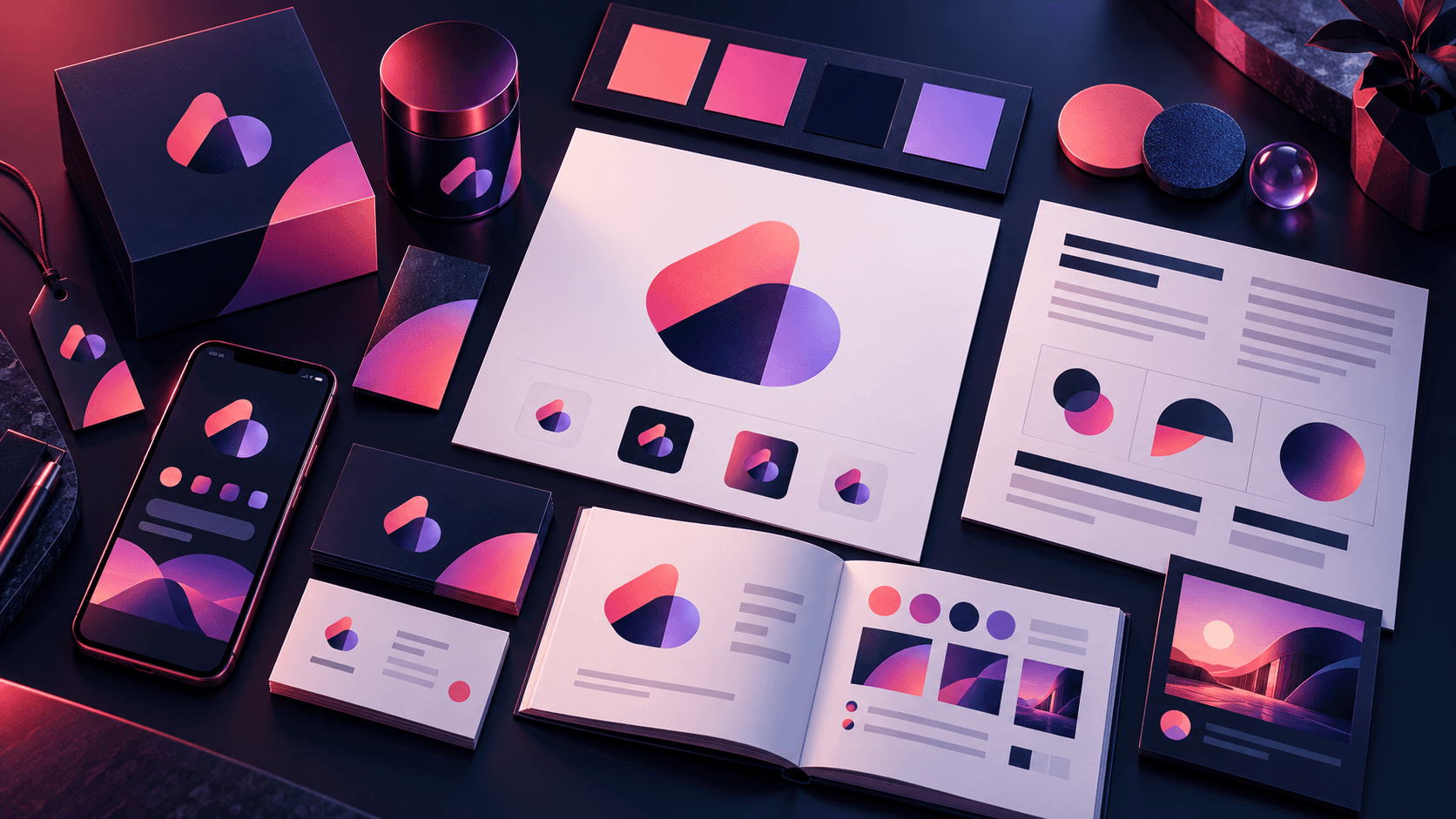
What Does Startup Branding Include?
A scalable startup branding system usually has six connected layers:
Brand strategy: What the company stands for and where it competes.
Verbal identity: How the company communicates in Arabic and English.
Visual identity: How the brand looks across different channels.
Product experience: How the brand appears inside the product.
Launch and campaign system: How the brand enters the market and communicates over time.
Brand operations: How teams maintain consistency as production increases.
These layers should not operate independently.
The positioning influences the messaging.
The messaging influences the visual identity.
The visual identity influences the product and campaigns.
And all of them need to survive ongoing production.
Strategy → Positioning → Voice → Visual Identity → Product → Campaigns → Production
1. Brand Strategy and Positioning
Before designing a logo, a startup needs to know what it is trying to communicate.
A Saudi startup branding strategy should establish:
Target audience
Customer problem
Market category
Competitive context
Brand promise
Differentiation
Key benefits
Reasons to believe
Business objectives
Growth markets
The purpose is not to create more documents.
It is to create clarity.
A startup should be able to explain what it does, who it serves, and why it matters without relying on its visual identity to do all the work.
Positioning for growth-stage startups
As the company expands, the strategy may need to address:
New customer segments
New products
New markets
Regional expansion
Competitive messaging
Employer branding
Investor communication
Brand architecture
This is where startup branding becomes more strategic.
The identity needs to support where the business is going, not only where it is today.
2. Arabic and English Verbal Identity
For many Saudi startups, communication happens in both Arabic and English.
That creates a branding challenge that translation alone cannot solve.
A technically accurate translation can still sound unlike the brand.
A strong verbal identity defines:
Brand voice
Tone of voice
Messaging pillars
Key phrases
Terminology
Arabic communication style
English communication style
Formality level
Words to use
Words to avoid
Arabic should not be treated as a translated version of English.
The two languages may communicate the same strategic idea while using different phrasing, rhythm, references, and levels of formality.
For digital products, teams also need to consider right-to-left implementation across interfaces and content.
This means Arabic branding needs to exist at the strategy, copy, design, and production levels.
3. Visual Identity for a Saudi Startup
Visual identity is often the most visible part of a branding project.
It can include:
Logo system
Color palette
Typography
Photography direction
Illustration style
Iconography
Graphic elements
Layout principles
Motion language
Social media templates
Presentation templates
But a startup identity should be designed for more than a brand guidelines document.
It needs to work across:
Websites
Apps
Social media
Video
Advertising
Product interfaces
Presentations
Events
Campaigns
A useful test is simple:
Would someone recognize the brand if the logo were removed?
The strongest identities develop recognizable visual behaviors beyond the logo itself.
4. Branding and Product Experience
For technology startups, the product is part of the brand.
Customers do not experience a company only through its advertising.
They experience it through:
Website
App
Onboarding
Dashboards
Navigation
Notifications
Empty states
Error messages
Microcopy
Checkout
Customer support
Imagine a startup with premium advertising, polished social media, and an impressive website.
Then the user opens the product and encounters a completely different visual language and tone.
The disconnect weakens the brand experience.
That is why startup branding should connect marketing and product teams.
The customer should encounter the same underlying brand personality before, during, and after conversion.
5. Launch Branding and Campaigns
A startup launch is more than announcing a new logo.
A complete launch system can include:
Launch campaign
Website
Product announcement
Social media
Founder communication
PR materials
Paid advertising
Product demo
Explainer video
Investor materials
Sales presentations
Email communication
The important principle is one campaign, many executions.
The website should feel related to the social content.
The social content should feel related to the launch film.
The paid ads should feel like part of the same creative system.
This is where a clearly defined visual and verbal identity becomes operationally useful.
6. Brand Operations
A startup may begin with one founder and one designer.
Eventually, it may involve:
Marketing teams
Designers
Freelancers
Agencies
Social media managers
Video teams
Regional teams
AI tools
Every additional contributor creates another opportunity for the brand to drift.
Brand operations help prevent that.
A scalable system can define:
Brand ownership
Approval processes
Asset libraries
Templates
Brand rules
Content standards
Localization rules
AI usage guidelines
Review processes
The goal is not to make every piece of content identical.
The goal is to make every piece of content recognizably part of the same brand.
Saudi Startup Branding Deliverables Checklist
A practical branding project can be divided into several workstreams.
Brand Strategy
Core
Brand positioning
Audience definition
Competitive analysis
Brand promise
Differentiation
Messaging pillars
Brand personality
Growth Stage
Brand architecture
Product positioning
Regional expansion strategy
Employer brand strategy
Portfolio positioning
Competitive messaging
Verbal Identity
Core
Brand voice
Tone of voice
Messaging framework
Tagline
Key messages
Arabic communication guidelines
English communication guidelines
Growth Stage
Regional language guidelines
Campaign messaging frameworks
Content style guide
AI prompting standards
Localization rules
Visual Identity
Core
Logo system
Color palette
Typography
Photography direction
Graphic elements
Iconography
Social templates
Growth Stage
Motion guidelines
Video style
Campaign systems
Event branding
Regional adaptations
Production templates
Product Branding
Core
UI direction
UX principles
Product language
Onboarding direction
Interface components
Growth Stage
Design system
Product brand governance
Multi-product identity
Product architecture
Launch and Campaigns
Core
Launch campaign
Website direction
Social assets
Product visuals
Presentation materials
Video content
Growth Stage
Paid campaign systems
Regional campaigns
Always-on content
Performance creative systems
Brand Operations
Core
Brand guidelines
Asset library
Approval process
Brand ownership
Growth Stage
Brand governance
AI content rules
Centralized brand references
Automated content workflows
Why a Brand Identity Alone Is Not Enough
A startup can have a well-designed identity and still struggle to maintain consistency.
Consider a company with:
A strong logo
A clear color system
Defined typography
A polished website
Professional brand guidelines
Now imagine the marketing team starts producing 100 campaign assets using different designers, agencies, and AI tools.
The first asset looks correct.
The fifth introduces a slightly different visual style.
The twentieth uses different colors.
The recurring character changes.
The product packaging looks different.
The campaign begins to feel like several brands rather than one.
This is the difference between brand identity and brand operations.
Identity defines what the brand is.
Operations determine whether that identity survives production.
Four Types of Brand Consistency
As content production increases, startups need to protect more than their logo and colors.
Four areas are particularly important.
1. Brand Consistency
The broader identity should remain recognizable across:
Brand personality
Voice
Colors
Visual language
Messaging
Positioning
Communication style
This applies across traditional production and AI-assisted content.
2. Product Consistency
If a startup repeatedly shows the same product, interface, or packaging, those elements need to remain accurate.
Important references can include:
Shape
Color
Materials
Packaging
Product details
Proportions
Interface characteristics
This becomes particularly relevant for ecommerce, consumer products, SaaS, CGI, and product-led campaigns.
3. Character Consistency
Recurring characters can become important brand assets.
These might include:
Brand mascots
Animated characters
Founder avatars
Recurring presenters
Spokespeople
Character documentation can establish:
Face
Hair
Clothing
Body characteristics
Personality
Expression range
This allows the character to appear across multiple campaigns without being redesigned from scratch.
4. Environment Consistency
Some startups build recurring visual worlds around their products or characters.
Environment references can define:
Location
Lighting
Atmosphere
Set design
Background
Spatial style
Environmental details
This is particularly useful for cinematic campaigns, animation, recurring video series, and branded worlds.
How AI Is Changing Startup Branding
AI increases the speed at which startups can create content.
That creates an interesting branding problem.
The challenge is no longer simply:
Can we produce this asset?
It becomes:
Can we produce hundreds of variations without losing the identity?
AI-generated images and videos can introduce differences in:
Characters
Products
Environments
Typography
Colors
Composition
Visual style
Brand tone
For this reason, AI should not sit outside the brand system.
Brand rules, references, approved assets, characters, products, environments, and visual styles should be built into the production workflow.
The faster content production becomes, the more important brand governance becomes.
A Saudi Startup Brand Journey
Consider a fictional Saudi technology startup preparing to launch a consumer platform.
Stage 1: Strategy
The company defines:
Target customer
Market position
Differentiation
Brand promise
Business objectives
The strategic foundation is now clear.
Stage 2: Identity
The startup develops:
Logo
Color system
Typography
Photography direction
Voice
Messaging
The brand now has a recognizable identity.
Stage 3: Product
The identity moves into:
Website
App
Onboarding
UI
Product messaging
Customers begin experiencing the brand directly.
Stage 4: Campaign
The marketing team creates:
Social posts
Videos
Paid ads
Product visuals
Launch assets
This is where production complexity begins.
Stage 5: Scale
The company enters new channels and potentially new markets.
More people create content.
More AI tools generate variations.
More languages introduce localization requirements.
At this stage, branding needs to become an operational system.
How Animus Agency Supports Startup Brands
A branding project should not necessarily end when the logo and guidelines are delivered.
As the startup grows, the brand may need to move into:
Campaigns
Social content
Branded films
Animation
Motion graphics
CGI
Product videos
Presentations
Events
Arabic and English adaptations
Animus Agency connects brand strategy and identity with creative production.
That can include practical production references such as:
Brand guidelines
Character sheets
Product references
Environment guides
Campaign templates
Motion direction
Visual production standards
The objective is to make the brand easier to produce consistently.
Instead of repeatedly moving through:
Create → Review → Fix → Rebuild
the process can become:
Define → Produce → Review → Scale
Branding Agency vs In-House Team vs Hybrid Model
There is no single operating model for every startup.
The right structure depends on the startup's stage, team, production requirements, and internal capabilities.
Working With a Branding Agency
External creative support can be useful when a startup needs:
Brand strategy
Positioning
Naming
Identity development
Creative direction
Market research
Launch strategy
Campaign production
A creative agency can also support animation, motion graphics, CGI, video, and social content after the core identity is established.
Building In-House
An internal team can make sense for startups with:
Established marketing functions
Frequent content requirements
Internal creative leadership
Existing brand governance
Dedicated production resources
The challenge is maintaining enough specialist capability as production expands.
Hybrid Production
A hybrid model combines internal ownership with external strategic and creative support.
For example, the startup may retain ownership of the brand internally while working with Animus Agency on:
Campaigns
Creative direction
Video
Animation
CGI
Social content
AI-assisted production
Brand consistency
The important question is not simply who produces the work.
It is who owns the brand system, who creates the work, and how both sides stay aligned.

How to Build a Scalable Startup Brand
A practical process can follow seven steps.
Step 1: Define the Strategic Foundation
Document:
Positioning
Audience
Differentiation
Brand promise
Business objectives
Brand values
Step 2: Build the Verbal Identity
Define how the startup communicates in Arabic and English.
Step 3: Build the Visual System
Create an identity flexible enough for websites, apps, campaigns, social media, video, and presentations.
Step 4: Connect the Brand to the Product
Make sure the website, app, onboarding, interface, and product communication reflect the same brand.
Step 5: Create Campaign Rules
Define how the brand adapts across:
Social media
Video
Paid advertising
Events
Launch campaigns
Sales materials
Step 6: Build Brand Memory
Centralize important brand references and recurring assets so teams do not have to reconstruct the brand for every project.
Step 7: Measure and Improve
Track both brand performance and production efficiency.
A Practical 90-Day Startup Branding Plan
Days 1–30: Strategy
Focus on:
Market research
Audience
Positioning
Differentiation
Messaging
Brand personality
Goal: clarity.
Days 31–60: Identity
Develop:
Visual identity
Verbal identity
Product direction
Website direction
Social system
Campaign templates
Goal: recognition.
Days 61–90: Activation
Launch:
Website
Social content
Campaign assets
Product communication
Paid advertising
Sales materials
Then document the workflows that will keep the brand consistent.
Goal: scalability.
How to Measure the ROI of Startup Branding
Branding does not have to be measured only through subjective feedback.
Startups can track three groups of indicators.
Commercial Metrics
Conversion rate
Lead quality
Customer acquisition cost
Sales cycle length
Website conversion
Demo requests
Customer retention
Brand-driven demand
Brand Metrics
Brand awareness
Branded search
Direct traffic
Engagement
Brand recall
Customer perception
Share of voice
Production Metrics
These are particularly useful when a startup produces a large amount of content.
Track:
Time required to create an asset
Number of revisions
Number of rejected assets
Localization time
Cost per approved asset
Assets produced per team member
One simple measurement is:
Cost per approved asset = Total production cost ÷ Number of approved assets
If clearer brand systems reduce revisions and production time, the operational benefit can be measured alongside traditional brand metrics.
Who Needs Startup Branding in Saudi Arabia?
Technology Startups
Technology companies need to communicate complex products quickly across product, marketing, sales, and investor channels.
Ecommerce Startups
Ecommerce brands need consistent product presentation across websites, marketplaces, social media, and advertising.
Fintech and SaaS Startups
Trust, clarity, product experience, and consistent communication are particularly important when the product involves complex services or digital workflows.
Consumer Startups
Consumer brands need identities that can move across packaging, social media, advertising, video, retail, and digital experiences.
Startups Expanding Regionally
Companies entering markets beyond Saudi Arabia need a brand system that can adapt to different languages and audiences without losing its core identity.
AI-Powered Startups
Startups producing high volumes of AI-generated content need stronger systems for controlling visual and verbal consistency.

Common Startup Branding Mistakes
1. Starting With the Logo
A logo cannot solve unclear positioning.
Start with strategy.
2. Treating Arabic as Translation
Arabic communication should reflect the brand's personality and audience rather than simply translating English copy.
3. Designing Only for the Launch
The identity should be designed for the content the company expects to produce six or twelve months later.
4. Ignoring the Product
The product is one of the most important brand touchpoints for a digital startup.
5. Creating Guidelines Nobody Uses
A 100-page brand document is not useful if the team cannot apply it to everyday production.
6. Using AI Without Brand Controls
AI can increase production speed while also increasing inconsistency.
The brand system needs to be part of the AI workflow.
7. Over-Standardizing the Brand
Consistency does not mean making every asset identical.
A good system creates guardrails, not handcuffs.
Best Practices for Startup Branding in Saudi Arabia
1. Start With Strategy
Understand the market, customer, category, and business objectives before designing.
2. Design for Arabic and English
Build bilingual communication into the system from the beginning.
3. Design for Digital
Make sure the identity works across websites, apps, social media, video, and advertising.
4. Connect Brand and Product
The product should feel like the same company customers encountered in the marketing.
5. Plan for Content Volume
Ask how the identity will perform when the startup needs 10 assets, 100 assets, or 1,000 assets.
6. Build Reusable Systems
Templates, references, asset libraries, and clear guidelines make ongoing production easier.
7. Protect Recurring Assets
Characters, products, environments, and visual worlds need consistency just like logos and colors.
8. Localize Intelligently
Saudi-facing content should feel culturally relevant while remaining connected to the overall brand.
9. Measure Production Efficiency
Track revisions, production time, approval rates, and cost per approved asset.
10. Build AI Into the Brand System
If generative AI is part of the production workflow, brand rules should be available within that workflow rather than manually recreated for every asset.
How to Evaluate a Startup Branding Agency in Saudi Arabia
Before choosing a branding partner, ask these questions.
Can They Explain the Strategy?
The agency should be able to explain why the brand is positioned a certain way, not only show visual references.
Can They Work in Arabic and English?
Look for experience with Arabic communication, localization, typography, tone, and cultural context.
Can the Identity Scale?
Ask to see how the brand works across:
Social media
Websites
Apps
Video
Advertising
Presentations
Events
Do They Understand Digital Products?
For technology startups, branding should connect with product experience.
Can They Support Ongoing Production?
A brand is not finished when the logo is delivered.
Ask how the agency will help maintain consistency six months or one year after launch.
Can They Work With AI?
If your startup uses generative AI, ask how the agency protects consistency across AI-generated images, videos, characters, products, and environments.
Startup Brand Readiness Checklist
Before scaling your marketing, ask:
Is our positioning clearly defined?
Can the team explain the value proposition in one sentence?
Is our Arabic communication style documented?
Is our English communication style documented?
Does the visual identity work across digital channels?
Does the product reflect the brand?
Are campaign rules clearly defined?
Can different team members create content that still feels consistent?
Are recurring characters and products documented?
Can AI tools access and apply our brand references?
Do we have a clear approval and asset-management process?
If several answers are no, the issue may not simply be the visual identity.
It may be a brand operations problem.
Frequently Asked Questions
What is startup branding in Saudi Arabia?
Startup branding in Saudi Arabia is the process of defining and expressing a startup's positioning, personality, messaging, visual identity, and customer experience for the Saudi market. It can include strategy, Arabic and English communication, visual identity, product experience, launch campaigns, and ongoing brand management.
How much does startup branding cost in Saudi Arabia?
The cost depends on the startup's stage, project scope, research requirements, identity complexity, product needs, and whether the project includes ongoing campaign or production support. A visual identity project will typically have a different scope from a complete branding system covering strategy, product, campaigns, and brand operations.
Should a startup hire a branding agency or build its brand in-house?
The answer depends on the startup's internal capabilities and stage. Some startups use external strategic and creative expertise during the initial branding phase and build internal capabilities later. Others use a hybrid model where the internal team owns the brand while an external agency supports strategy, creative direction, and production.
Is branding important for Saudi technology startups?
Branding can help technology startups communicate complex products more clearly and create consistency across product, marketing, sales, and investor communication. Its impact depends on the quality of the underlying product, positioning, distribution, and customer experience.
How does AI affect startup branding?
AI increases the amount of content a startup can produce, but it can also introduce inconsistency across images, videos, characters, products, environments, and messaging. A documented brand system can help teams maintain recognizable creative direction across AI-assisted production.
What should a Saudi startup branding agency deliver?
The scope depends on the project, but a comprehensive engagement can include brand strategy, positioning, verbal identity, visual identity, Arabic and English communication guidelines, product direction, campaign systems, brand guidelines, templates, and production references.
Can a branding agency work with an internal marketing team?
Yes. A hybrid model can combine internal brand ownership with external strategic, creative, and production support. Clear guidelines, references, templates, and approval workflows help both teams stay aligned.
How can startups maintain brand consistency as they scale?
Startups should document the brand identity, centralize important assets, establish production standards, define approval processes, and build recurring brand references into their content workflow. For AI-generated content, these references can help reduce variation between outputs.
Conclusion: Build a Brand That Can Grow With the Startup
Startup branding in Saudi Arabia is no longer only about creating a recognizable visual identity. It is about building a system that can survive growth.
A scalable startup brand connects:
Strategy → Positioning → Voice → Visual Identity → Product → Campaigns → Production
The first stage is deciding what the company stands for.
The second is making that identity recognizable.
The third is making it operational.
That final stage becomes increasingly important as startups expand across channels, markets, languages, and AI-assisted production.
The goal is not simply to produce more content.
It is to produce more content without losing the identity that makes the company recognizable.
Animus Agency works across brand strategy, identity, animation, motion graphics, CGI, video production, social content, and campaign production to help startups turn brand identity into an active creative system.